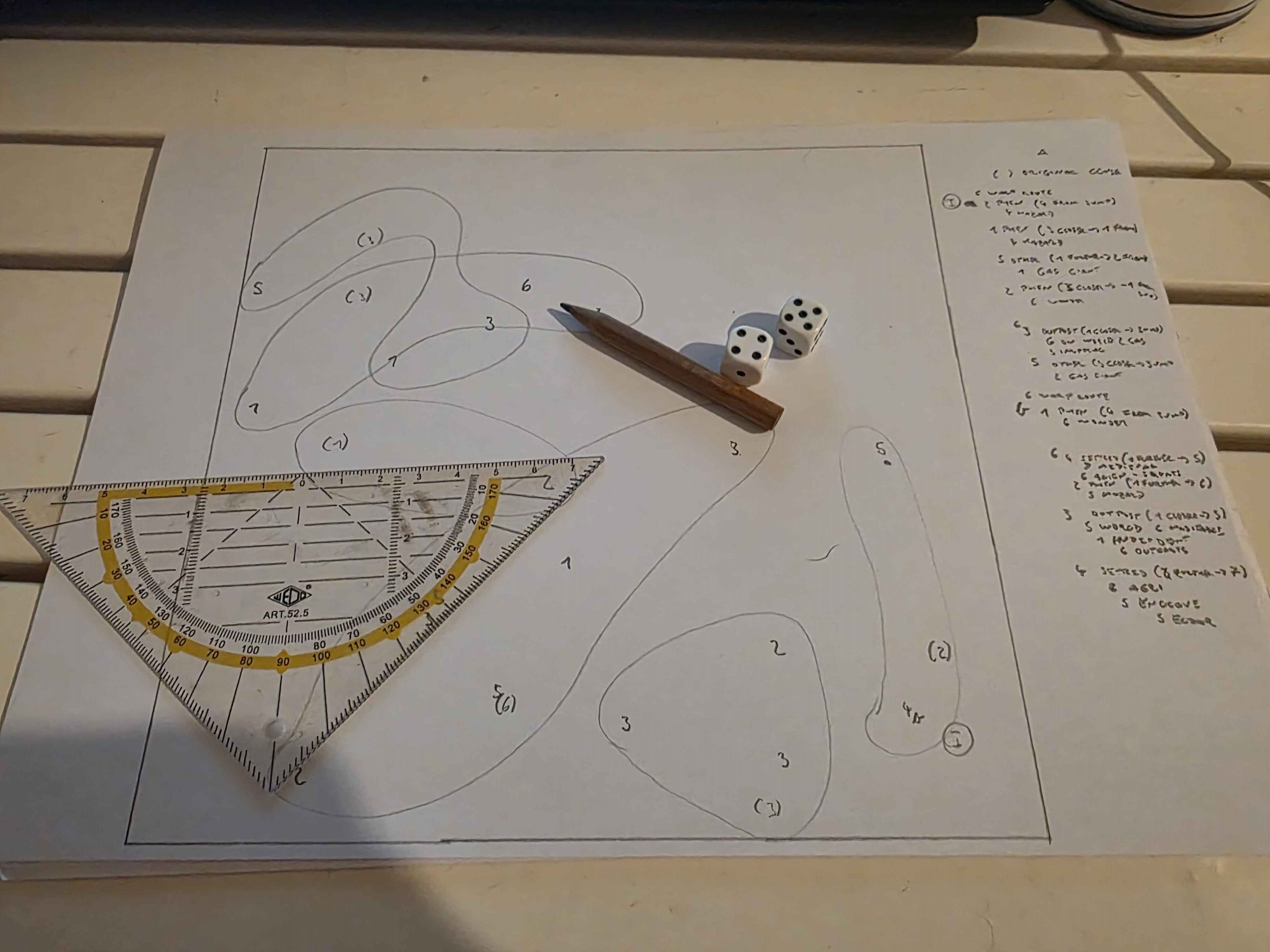

There are any number of systems out there which can be used to generate sectors of space and the worlds within and things like Classic Traveller would be a natural fit for Epic Roleplay. Yet, this here is one more system for generating sectors and worlds for potential use with Epic Roleplay.
Step 1: Sector Generation
Prepare an empty sector map by delineating a 20 cm x 20 cm square, scale 1 cm = 10 lightyears
Determine the number of subsectors within the sector (choose or randomly generate with 2d6).
Drop a number of d6 equal to the number of subsectors onto the sector map. Mark their positions and their results.
Each die represents the approximate location of a subsector containing a number of clusters equal to the die’s result.
Step 2: Subsector Generation
For each subsector, prepare an empty subsector map by delineating a 20 cm x 20 cm square, scale 1 cm = 1 lightyear
Drop a number of d6 equal to the number of clusters onto the subsector map. Mark their positions and their results.
Each die represents the approximate location of a cluster within the subsector, containing a number of systems equal to the die’s result.
While a subsectors is characterized by the relations of the worlds within it, clusters are groups of systems – inhabited or not – within a subsector that bear especially close ties to one another, be they spatial, historical, economical, or esoteric.
Step 3: Cluster Generation
For each cluster, roll or drop a number of d6 equal to the number of systems onto the subsector map. Try to aim for the marked position of the cluster, but accept dice veering of the mark. Mark their positions and their results.
Each die represents the approximate location of one of the cluster’s systems within the subsector, containing a number of points of interest equal to the die’s result.
Also, determine the following for the cluster, using the tables below:
Cluster Warp Conditions
| D6 | Result |
| 1 | Treacherous – when determining System Warp Currents, treat all uneven results as a result of 1 instead |
| 2 | Unpredicatable – when determining System Warp Currents, treat results of 1-2 as 1 and results of 5-6 as 6 |
| 3-5 | – |
| 6 | Predictable – when determining System Warp Currents, treat all even results as a result of 6 instead |
Cluster Allegiance
| D6 | Result |
| 1 | Independent |
| 2-5 | Imperial |
| 6 | Alien – fully alien or occupied or ruled by aliens |
Optionally, if a cluster has at least one neighbouring independent cluster, a 2 is treated as independent, and if a cluster has at least one neighborung alien cluster, a 5 is treated as alien.
Cluster Stability
| D6 | Result |
| 1-2 | Splintered frontier – when determining system allegiance, and the system is either independent or alien, randomly generate details for each system |
| 3-4 | Splintered domination – when determining system allegiance, and the system is independent, randomly generate details for each system, if the system is alien, randomly generate the details only once for the entire cluster |
| 5 | Breakaway frontier – when determining system allegiance, and the system is independent, randomly generate the details only once for the entire cluster, if the system is alien, randomly generate details for each system |
| 6 | Breakaway domination – when determining system allegiance, and the system is either independent or alien, randomly generate the details only once for the entire cluster |
Details of independent allegiance
| D6 | Result |
| 1 | Population with no previous Imperial contact |
| 2-3 | Lost Imperial population |
| 4 | Recently rebelled |
| 5 | Successfully seceded in the past |
| 6 | Founded by rogue elements or outcasts – pirates, schismatics, deserters |
Details of alien allegiance
| D6 | Result |
| 1 | Squats |
| 2-4 | Orks |
| 5 | Eldar |
| 6 | Minor xenos |
Step 4: System Generation
For each system, roll to determine local warp conditions:
| D6 | Result |
| 1 | (Semi-)permanent warp storms – when plotting a course to or from the system, use a row one higher on the Jump Table than distance would normally indicate |
| 2-5 | – |
| 6 | Stable warp route – connect with one other systems that also possesses a stable warp route, travel between the connected systems uses a row one lower on the Jump Table than distance would normally indicate (note: if the connection is doubled, by having both systems connect to one another instead of forming a longer chain, the effects stack and a row two lower is used) |
Then, roll a number of d6 equal to the number of points of interest in the system to determine their nature:
| D6 | Result |
| 1-2 | Phenomenon |
| 3 | Outpost |
| 4 | Settled world |
| 5 | Other world |
| 6 | Roll again twice |
Also, randomly determine the distance of the points of interest from the system’s jump zone. For the first point of interest roll D6+1, this is the distance in plasma weeks. For any further points of interest roll D6, 1-2: the point is that many plasma weeks closer to the jump zone than the previous point of interest; 3: the point is the same distance from the jump zone than the previous point; 4-6: the point is further away from the jump zone than the previous point (deduct 3 from the result for the plasma weeks it is further away).
For phenomena, roll D6:
| D6 | Result |
| 1-2 | Resource – this could be a ring of extremely ore-rich asteroids, clouds of valuable exotic matter, or a salvage field |
| 3-5 | Hazard – a mere navigational inconvenience such as an extended sensor shadow hindering progress, a dangerous patch of space affected by destructive gravity tides or showers of destructive microdebris, or an actively hostile force such as an area seeded with hunter-killer space drones or the hunting ground of a space kraken or some malicious entity |
| 6 | Wonder – something useful, awe-inspiring, or simply beautiful |
For outposts, roll D6 to determine where they are located:
| D6 | Result |
| 1-3 | A space outpost – a deep space station or asteroid base |
| 4 | Within a phenomenon – roll for the phenomenon, the outpost is built into it or closely orbiting or trailing it |
| 5-6 | On another world – roll for the other world, the outpost is constructed on it or is orbiting it |
Also, determine the outpost’s allegiance using the system allegiance table below.
For settled worlds, roll 2D6 on the Homeworld table to determine the world’s type.
Optionally, roll a D6 to determine the health of the world, 1: ruins – the world is dead and abandoned but littered with remains and possibly scattered survivors; 2: struggling – the world is in decline; 3-5: holding its own; 6: thriving.
Determine the world’s allegiance using the system allegiance tables below.
For other worlds, roll D6:
| D6 | Result |
| 1-3 | Gas Giant |
| 4-5 | Uninhabitable |
| 6 | Habitable but unsettled – an opportunity waiting to be realised |
To determine the system allegiance for outposts and settled worlds, use the table below. Roll separately for each outpost and world.
| D6 | Result |
| 1 | Enclave – main allegiance is the same as the cluster allegiance, but there exists a substantial enclave of another allegiance, this might be hidden, exist in easy or uneasy peace, or might be hostile such as a substantial invasion force, roll for the enclave’s allegiance using the main cluster allegiance tables (if the result is the same as the main allegiance, then the enclave is of a separate internal faction) |
| 2-5 | Same as the cluser allegiance |
| 6 | Different than the cluster allegiance, roll for allegiance using the main cluster allegiance tables |
Finally, note everything on a system matrix.